
Mechanic Legends Car Flipping: Costs, Margins and Project Choices
Last updated:
A cheap Junkyard car can become an expensive restoration. Choose a project that leaves enough cash for repairs, then compare its actual sale proceeds with everything you spent on that car.
Car flipping profit equals sale proceeds minus the purchase price and all actual restoration costs, in in-game dollars. Inspect each listing before buying and budget for parts, rust removal, primer and paint. The $4,000 C4 and Wagon examples sold for $4,958 and $6,689 above their purchase prices, but those differences still need repair costs deducted. The MT8's $16,779 offer leaves only $27 after its $15,552 purchase and $1,200 in known bodywork costs, before any other spending.
Assess the Listing Before Spending
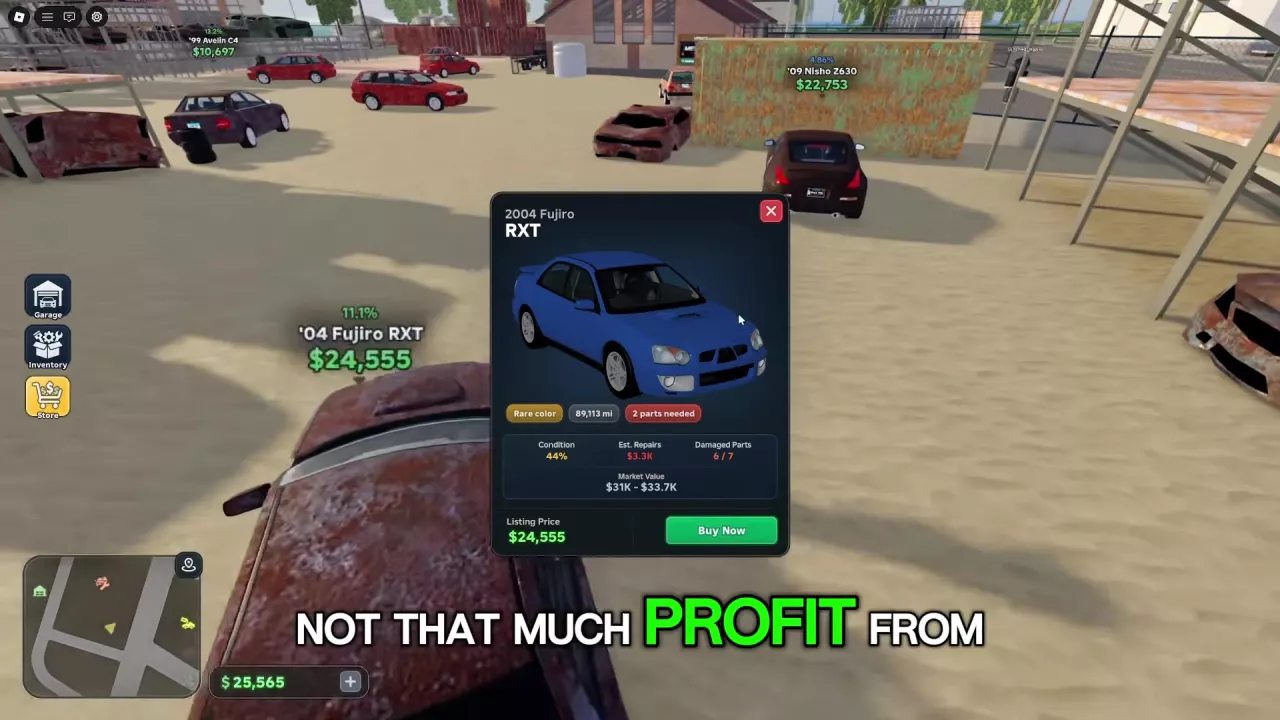
Read the asking price alongside condition, damaged parts, required parts, estimated repairs and market value. A low purchase price helps only if you can also afford to finish the work.
These individual listings illustrate the tradeoffs; their prices and estimates apply to those cars.
| Listing | Condition and parts | Estimated repairs | Estimated market value | Purchase plus repair estimate |
|---|---|---|---|---|
| 1999 Avelin C4 — $5,310 | 41% condition; 7/7 damaged parts; 3 parts required | About $2,300 | $8,500–$9,200 | About $7,610 |
| 2004 Fujiro RXT — $24,555 | 44% condition; 6/7 damaged parts; 2 parts required | About $3,300 | $31,000–$33,700 | About $27,855 |
For the C4, subtracting the purchase price and repair estimate from the market-value range leaves roughly $890–$1,590. The RXT leaves roughly $3,145–$5,845 on the same basis. Those are estimated gaps before additional costs, not net profits: the market range is not a dealer offer, and the repair estimate is not your final spending total.
The RXT offers more estimated room in dollars but ties up substantially more cash. The C4 is cheaper to enter, yet its narrow estimated gap makes additional spending especially important.
The 2009 Nisho Z630 purchased for $22,753 had an estimated repair burden of about $1,000, putting purchase plus estimated repairs at about $23,753. That makes it worth considering for a higher-budget project with a smaller repair allowance than the RXT example. It still needed an engine component despite being drivable with engine damage. A low repair estimate alone does not establish its resale margin.
Use the Junkyard inspection and buying guide for the purchase controls and stock-refresh process.
Subtract Every Cost for the Same Car
Net cash profit = sale proceeds − purchase price − total actual restoration costs.
Use in-game dollars throughout and keep every amount tied to the same car and restoration project. A positive result is a profit; a negative result is a loss.
- Record the purchase price.
- Add every actual restoration expense: replacement parts, paid rust removal and priming, paint, and any other spending for that car.
- Before selling, subtract that total investment from the dealer's offer to assess the proposed return.
- Once sold, use the actual sale proceeds to calculate the completed flip's profit.
Keep customer-job income, driving income, rewards and spending on other cars out of this calculation. Your overall cash balance mixes activities, so its change cannot reliably identify a car's repair bill.
Replacement parts can materially change the result. A separate Block and Exhaust Manifold order totaled $3,900—an expense to assign to the car receiving those parts, not automatically subtract from a different C4 or Wagon sale. Check part prices and engine labels when budgeting replacements.
For rusty bodywork, allow for prep before repainting. The Paint Shop guide explains the two services and how to complete them.
C4 and Wagon: Sale Difference Before Repairs
The $4,000 first-car examples leave substantially more room between purchase and sale than the MT8 example below. Keep them separate from other listings of the same models, including the $5,310 C4 above.
| First-car restoration example | Purchase price | Market estimate at purchase | Sale proceeds | Sale minus purchase, before restoration | Blue repaint cost |
|---|---|---|---|---|---|
| 1999 Avelin C4 | $4,000 | $8,200–$9,000 | $8,958 | $4,958 | $120 |
| 1998 Avelin C4 Wagon | $4,000 | $9,800–$10,700 | $10,689 | $6,689 | $140 |
After subtracting just the listed paint charges, the remaining differences are $4,838 for the C4 and $6,549 for the Wagon. Other restoration spending must still come out of those amounts.
The $4,000 Wagon had 91% condition, 1/7 damaged parts and an estimated-repairs label of “None.” That label did not eliminate bodywork charges: rust removal cost money, and the blue repaint cost $140. Treat mechanical repair estimates and paid bodywork as separate budget considerations.
For an $8,000 starting budget, either $4,000 purchase leaves $4,000 available for restoration. That makes a similarly priced C4 or Wagon a useful low-budget candidate when its actual repair needs fit the remaining cash. The Wagon example has the larger pre-cost sale difference, but judge the next listing by its own purchase price and work required.
MT8: A Small Margin After Bodywork
The 2003 Mizora MT8 cost $15,552 and received a $16,779 dealer offer after repairs, rust removal and a dark-green repaint. Its condition at that offer was Excellent (96%).
| Calculation | Amount |
|---|---|
| Dealer offer | $16,779 |
| Minus purchase price | −$15,552 |
| Difference before restoration costs | $1,227 |
| Minus rust removal and priming | −$1,000 |
| Minus paint | −$200 |
| Remaining before any other spending | $27 |
At that offer, purchase and these two bodywork charges already total $16,752. Any additional spending above $27 would turn the project into a cash loss.
Give a project with these costs and this offer low priority if your goal is profit. The higher sale price barely covers the known investment. A cheaper purchase or a higher individual offer would change the calculation; the MT8 name alone does not determine the return.
Choose the Project and Review the Dealer Offer
- For a small budget, start with an affordable C4 or Wagon listing that leaves a repair reserve. Their $4,000 examples make them useful candidates, but spending your whole budget on the purchase can leave the restoration unfinished.
- With more capital, compare the RXT's valuation gap against the Z630's lower estimated repair burden. The RXT example requires more cash for both purchase and estimated repairs. The Z630's smaller estimate makes it a candidate for lower repair spending, not an automatic profit winner.
- Pass over a narrow-margin project when profit is the goal. The MT8 calculation leaves almost no room for additional costs.
At the dealer, compare your car's offer with its total actual investment. Read applicable adjustments, such as a clean-example bonus, fresh-parts addition or gifted-car deduction; these can change the amount you receive. Do not substitute another car's sale price simply because it shares the same model name.
If the offer exceeds your total spending by an amount you consider worthwhile, selling realizes that return. If it does not, decide whether to accept the result or keep the car for driving. Keeping it does not realize resale income. Complete the dealer offer and sale steps only after making that decision; completed sales cannot be undone.
For a project you intend to keep or tune, compare the car choices by purpose. If a restoration would tie up too much of your available cash, the money guide compares customer work and other income options.